
Key Takeaways
- Glassnode says bitcoin trades near half its October 2025 peak while US stocks hit record highs.
- US equities set a fresh record on August 7 as AI-driven gains pull household cash off the sidelines.
- Core inflation held at 2.5% in July even as bitcoin failed to benefit from the shift out of cash.
A Confidence Paradox
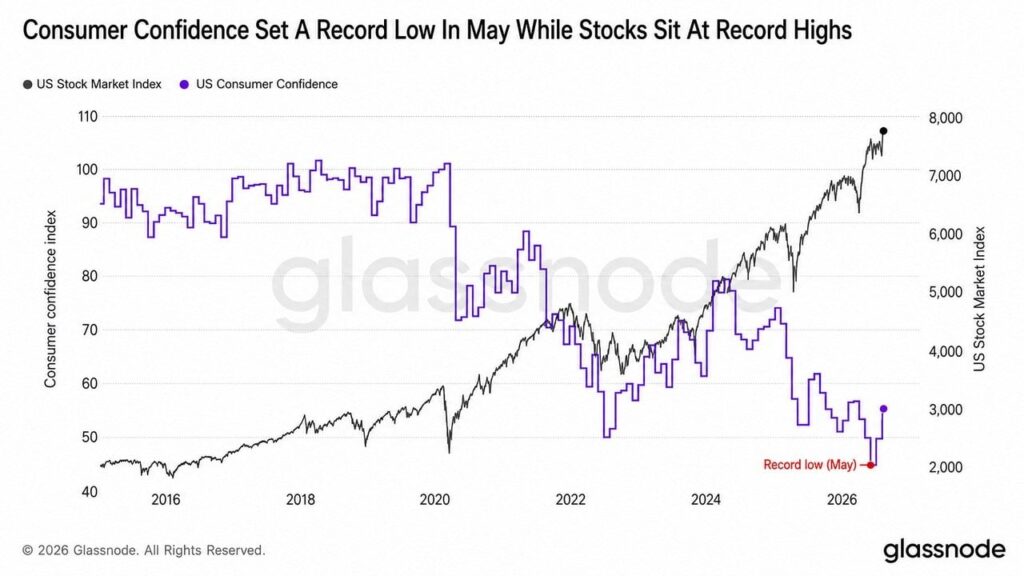
Consumer confidence remains, in Glassnode’s words, “among the weakest readings of the past decade,” even after two consecutive months of improvement. That weakness hasn’t stopped households from moving money out of cash and into assets as consumers continue to expect living costs to keep rising and the broader economy to soften. The twist, however, is still where that capital is landing.
U.S. equities set a fresh all-time high on August 7 and have held just beneath that level since, carried almost entirely by the artificial intelligence (AI) trade rather than a broad-based rally.
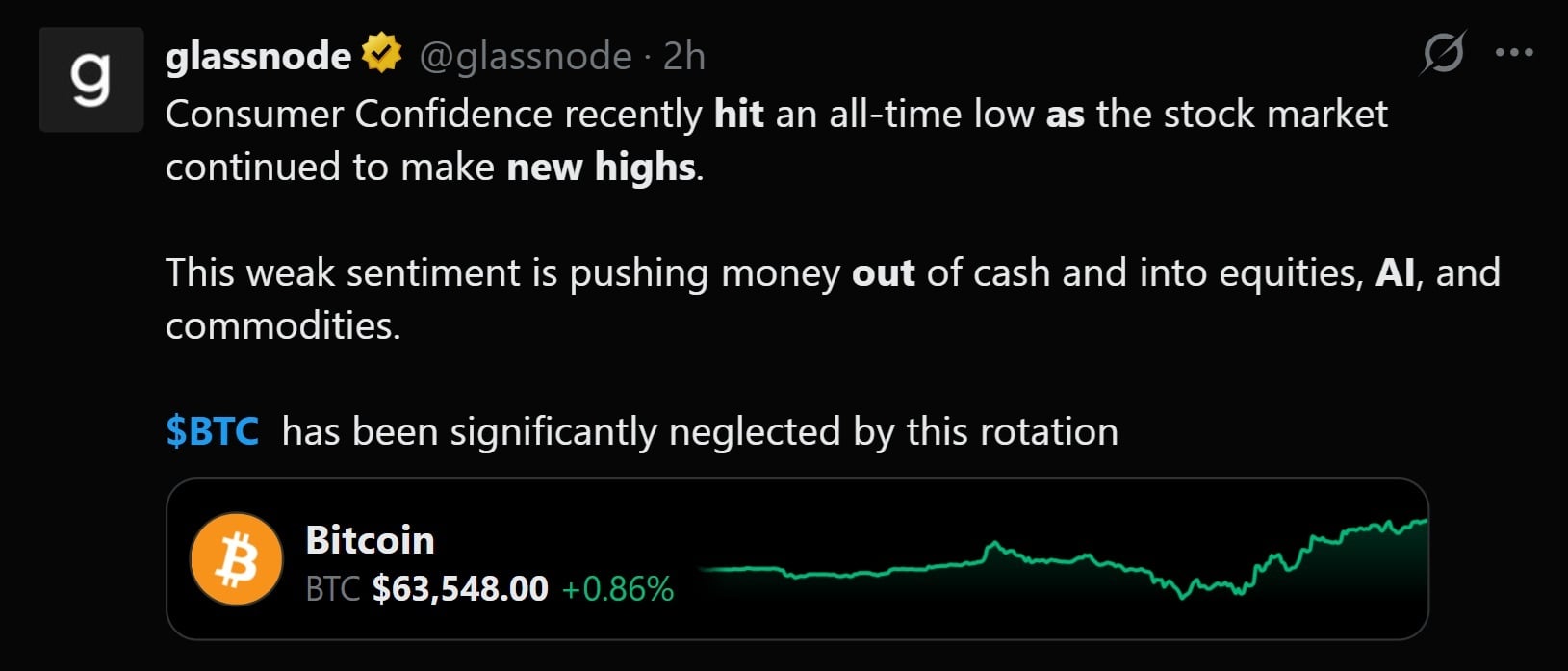
Bitcoin, historically pitched as the asset that benefits when consumers lose faith in the traditional financial system, has not been part of that move. Bitcoin.com News reported last week that spot bitcoin ETFs shed $389.7 million in a single week even as equity markets kept climbing, a split that lines up with Glassnode’s read on where capital is actually flowing this summer.
Where the Money Is Actually Going
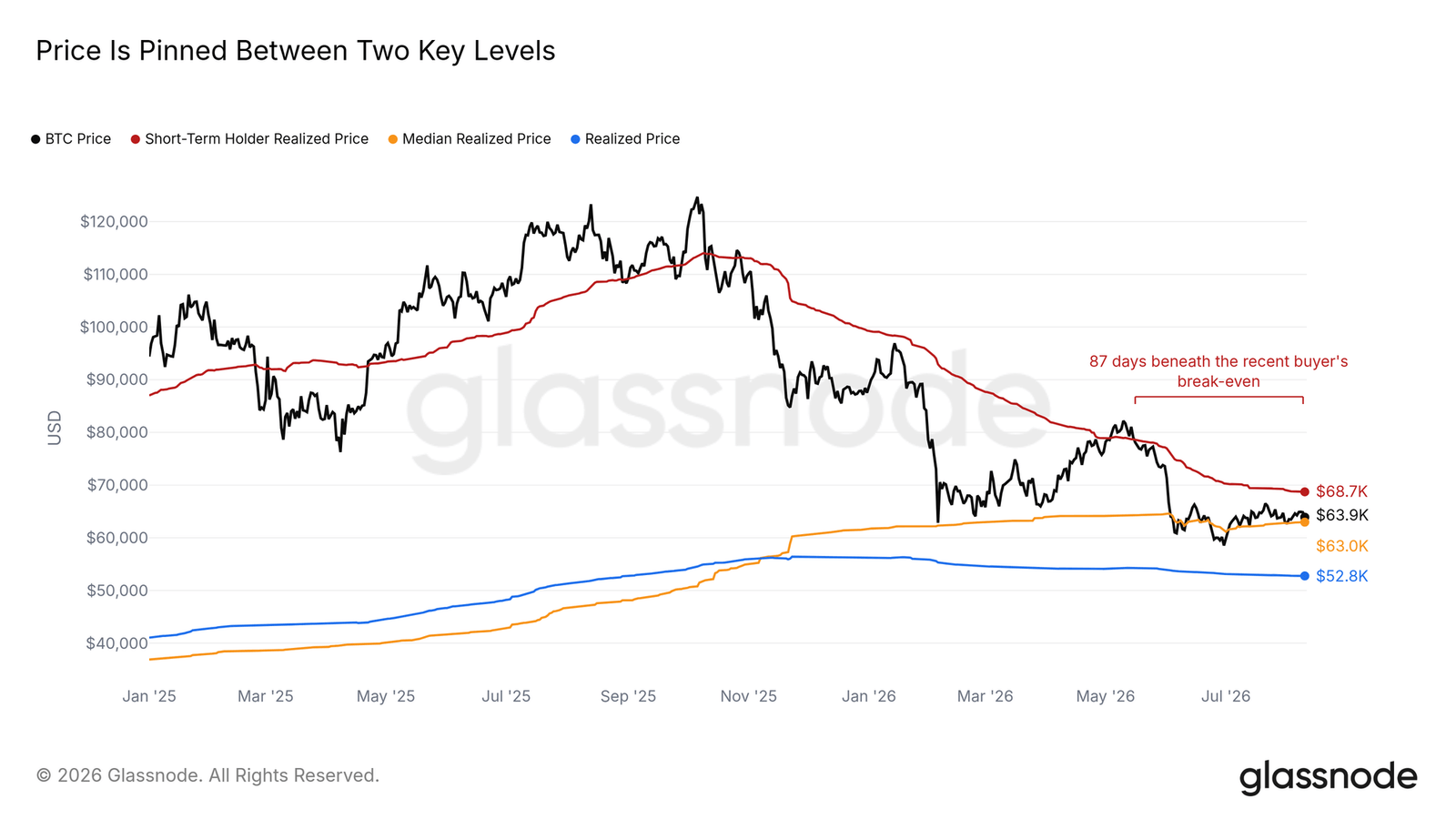
Bitcoin is currently trading at roughly half the level of its October 2025 peak, a steep drawdown that has left the asset wedged in a narrow band between its Median Realized Price near $63,000 and the Short-Term Holder Cost Basis around $68,700.
Meanwhile, the AI trade has kept attracting fresh capital, as individual traders, hedge funds, and even crypto-native institutions (that once championed bitcoin as their preferred hedge) are instead shifting exposure toward AI-focused equities and AI-linked crypto tokens.
The macro backdrop hasn’t been hostile to bitcoin, at least on paper, as core inflation printed at 2.5% in July, a relatively tame reading, and equities took that as good news, extending their record run. Bitcoin’s muted response to a benign inflation print is itself the warning sign researchers are flagging, given that the asset is supposed to thrive on debasement fears and loose monetary conditions.
Lastly, spot exchange trading volume for bitcoin has fallen to its lowest levels since 2019, with recent ETF inflows representing only “a small fraction of any past accumulation wave.” This could be indicative of the fact that institutional buying (which powered bitcoin’s 2024 and 2025 rallies) has gone quiet.
What It Means for Bitcoin
The pattern Glassnode describes, i.e. mining and technology companies pivoting capital and infrastructure toward AI rather than digital assets, is playing out beyond just trading flows. Some bitcoin miners have already begun repositioning their power contracts and data center capacity toward AI workloads, chasing the same capital rotation Glassnode is tracking in the equity markets.
From the outside looking in, the movement serves as a structural shift that could keep pressuring bitcoin’s narrative as the default destination for capital fleeing cash.
That said, none of this actually means that the debasement or scarcity case for bitcoin has been disproven, only that it isn’t playing out on the timeline crypto bulls expected this summer. Bitcoin.com News recently tracked a parallel argument that a mounting US national debt should be structurally bullish for bitcoin, a thesis that, like the AI-rotation story, has yet to show up clearly in price.