
Bitcoin has faced mounting liquidity pressure as the 30-day change in stablecoin market capitalization has fallen to approximately negative 12%, even as the cryptocurrency market records a short-term recovery.
Summary
- Bitcoin rises 2% to $61,719 despite a 12% monthly contraction in stablecoin supply.
- Ethereum gains 2.5% to $1,730.81, while Solana advances 3.5% to trade at $73.48.
- Tether and USDC hold a combined market capitalization of approximately $243 billion.
- CryptoQuant contributor CW_ reports signs of Bitcoin selling pressure being absorbed.
- 21Shares identifies Bitcoin’s realized price of $53,250 as a key downside level.
In a November 27 analysis, CryptoQuant contributor CryptoZeno warned that declining stablecoin supply was reducing the amount of readily available capital that could absorb selling pressure and support a sustained Bitcoin recovery.
Based on data from crypto.news, Bitcoin traded at $61,720 on November 27, up 2% over the past 24 hours, with daily trading volume reaching $23.17 billion and its market capitalization standing at $1.24 trillion.
Major altcoins recorded similar gains during the period. Ethereum rose 2.5% to $1,730, while BNB gained 1.8% to $560. Meanwhile, XRP advanced 2.6% to $0.98, and Solana climbed 3.5% to $73.
Stablecoin market capitalization contracts despite Bitcoin price recovery
CryptoZeno explained that stablecoins provide dollar-denominated liquidity for transactions across cryptocurrency exchanges, trading pairs and decentralized financial applications.
Although their market capitalization does not directly measure buying demand, an expanding supply provides traders with more capital that can be readily deployed across the cryptocurrency market.
Conversely, declining supply reduces the available funding pool, leaving recovery attempts increasingly dependent on capital already circulating within the market.
“Stablecoins are not a direct measure of buying pressure,” CryptoZeno noted.
The analyst observed that periods of stablecoin expansion frequently coincided with rising Bitcoin prices during the 2024–2025 rally. However, the relationship has not always been consistent, with changes in stablecoin supply sometimes preceding movements in Bitcoin price.
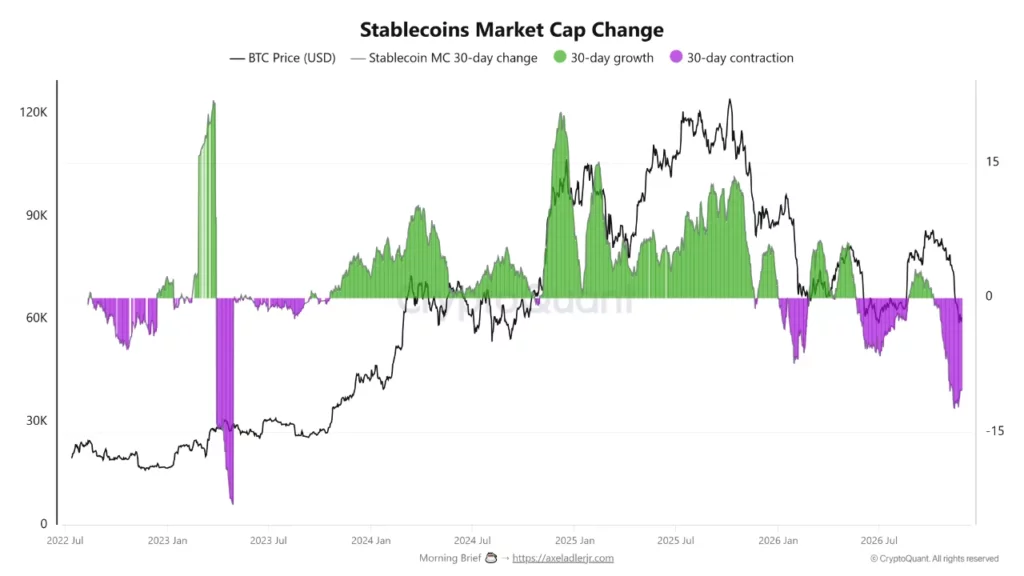
Temporary contractions in stablecoin supply have not necessarily resulted in prolonged bear markets, while unusual fluctuations recorded in early 2023 demonstrate the limitations of interpreting individual readings as definitive market signals.
CryptoZeno identified three conditions that would make a sustained bullish reversal more convincing: a slowdown in stablecoin contraction, a return to positive monthly supply growth and an improvement in Bitcoin’s price structure.
Until those conditions emerge, the analyst warned that limited liquidity could leave recovery attempts vulnerable to another correction.
Despite the recent contraction identified by CryptoZeno, Tether (USDT) and USD Coin (USDC) continue to account for substantial amounts of dollar-denominated capital circulating within the cryptocurrency market.
USDT maintained a market capitalization of approximately $173.85 billion on November 27, while USDC accounted for another $69.15 billion.
Combined daily trading volume across the two stablecoins reached $45.35 billion, with Tether accounting for $35.79 billion and USDC recording $9.55 billion.
Bitcoin demand shows signs of stabilization despite selling pressure
Despite concerns surrounding stablecoin liquidity, another CryptoQuant contributor, CW_, identified signs that Bitcoin’s recent selling pressure was being absorbed.
In a November 27 assessment, the analyst noted that negative Bitcoin demand readings had remained around similar levels for five consecutive days without a corresponding deterioration in price during the period examined.
“Someone is absorbing the selling $BTC, effectively offsetting the downward pressure,” CW_ wrote.
The analyst explained that a reduction in negative demand readings, accompanied by a price recovery, could create more favorable conditions for a rebound.
Although Bitcoin’s demand indicator remained negative, CW_ noted that the cryptocurrency’s ability to withstand selling pressure could provide a foundation for price recovery if demand conditions improve.
21Shares identifies $53,250 as a key Bitcoin downside level
Institutional investment flows remain another factor affecting Bitcoin’s recovery.
Cryptocurrency asset manager 21Shares found that stablecoin supply had contracted by $10.7 billion over an 18-day period, representing its largest dollar-denominated decline over that timeframe since the Terra ecosystem collapsed in 2022.
Stablecoin balances held on cryptocurrency exchanges fell 15%, while US spot Bitcoin and Ethereum exchange-traded funds recorded combined net withdrawals of $3.9 billion between October 30 and November 13.
As crypto.news previously reported, the researchers identified Bitcoin’s $53,250 realized price as an important downside reference level. The metric estimates Bitcoin’s average on-chain cost basis using the price at which individual coins last moved.
Having fallen below its 200-week moving average near $68,000, Bitcoin would need to recover the $73,000–$75,500 region to demonstrate stronger upward momentum, the researchers said.
The asset manager identified sustained institutional inflows through spot Bitcoin ETFs and renewed growth in stablecoin balances on exchanges as two developments that could support a more durable market recovery.
Disclosure: This article does not represent investment advice. The content and materials featured on this page are for educational purposes only.