
The first week of the French Open has yielded as many major upsets (two) as people collapsing on the court due to sweltering conditions.
While temperatures in Europe are extremely hot for this time of year, they aren’t Sahara-in-the-middle-of-summer hot. To truly understand why people on the court are struggling amid the heat, you need to look at an obscure measure known as the wet bulb globe temperature. Consider it a souped-up version of the adage “it’s not the heat, it’s the humidity” that’s best suited for gauging the impact of heat on human health.
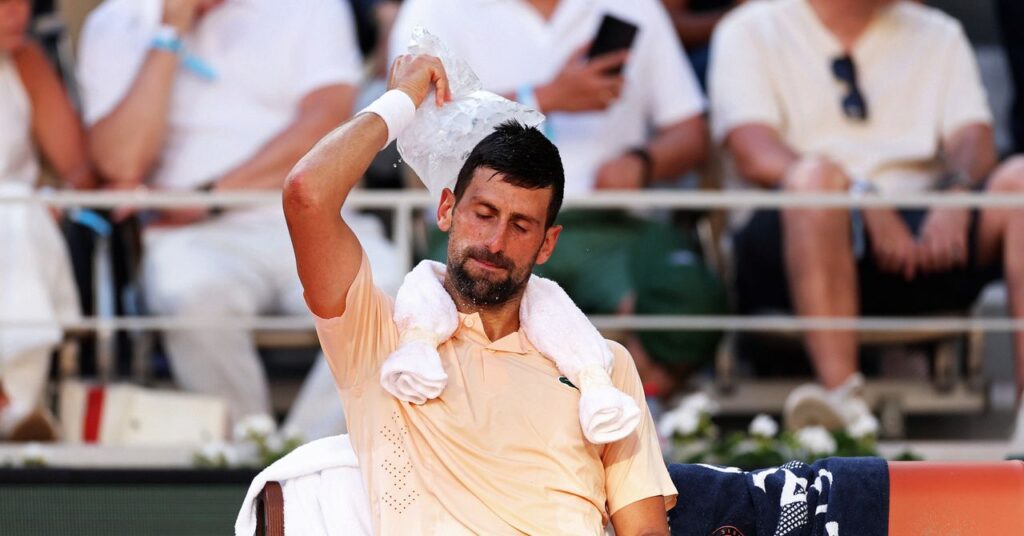
A ball girl nearly fainted during a first round match on Monday while men’s player Jakub Mensik keeled over on Roland Garros’ red clay on Thursday after a five-set match, saying his body “just turned off.” Players have spent time between games sitting in the shade and putting bags of ice on their heads and shoulders, all in an attempt to beat the oppressive heat.
Temperatures have hovered in the low- to mid-90s (or low-30s for Celsius aficionados), due to a “heat dome”, a persistent area of high pressure that traps warm air and causes temperatures to rise. This is where the wet bulb globe temperature comes in.
The metric “takes into account multiple aspects of the environmental conditions such as temperature, humidity, solar radiation, and wind,” says Rachel Cottle, a postdoctoral research fellow at Texas Health Presbyterian Hospital Dallas. “This is important because when we think about how stressful the environment is, we need to take into account all of these variables that may increase our risk for heat-related illnesses.”
A wet bulb globe temperature of 86 degrees Fahrenheit (30 degrees Celsius) might not sound that bad, but it represents the start of the danger zone for human health. At that temperature, sweat doesn’t evaporate as efficiently as it does at lower temperatures. Cottle has conducted research showing that even healthy young people start to experience issues when the wet bulb temperature—a measure that focuses on humidity and temperature—reaches around 88 degrees Fahrenheit (31 degrees Celsius).
“While there is still a limit for athletes, their greater cardiovascular fitness and potentially, being heat acclimated will result in them having higher limits than non-athletes and non-acclimated people,” said health researcher Kat Fisher. “Going to shade and cooling the body with ice can help lower core temperature and help limit a continuous rise in temperature.”
Having better endurance isn’t all athletes have going when it comes to beating the heat. “Athletes and individuals who are fit sweat more which helps them cool off more. They also begin to sweat earlier, so their bodies can start to cool off sooner. So essentially, athletes are more efficient sweaters,” Cottle notes, while also underscoring even the most efficient sweaters walking among us mere mortals have their limits. Without ample rest and access to cooling, the risk of heatstroke or heart issues rises.
The French Tennis Federation reportedly keeps two thermometers that can measure the wet bulb globe temperature on courts at Roland Garros, with plans in place to have extended breaks between sets or even cancel matches if they surpass a certain threshold. Wet bulb globe temperatures at the French Open haven’t reached these levels yet despite some matches taking place during the hottest times of the day on courts with no shade. But the health issues on the court have shown the risks, and temperatures are expected to be even higher in the coming days as the heat dome parked over the region intensifies.
The other three Grand Slam tennis events—Wimbledon, the Australian Open and the US Open—have heat plans in place that allow players to take longer rests and cool off. All the events rely on wet bulb globe measurements to implement them.