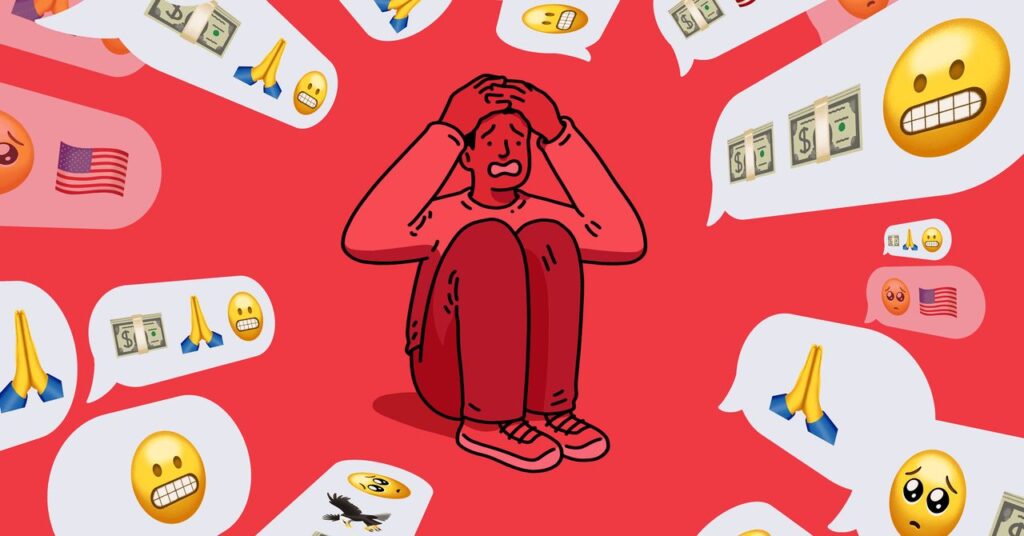
They’re meant for a family member who I’ll call John, for privacy reasons. John lives in California and has made small donations to Democrats. I live in New York and have made no political donations at all. We have different names, phone numbers, and bank accounts—a distinction that has apparently proven difficult for a substantial portion of the American political fundraising industry.
For years, I diligently opted out. I’ve replied “STOP” 49 times since 2021, by my phone’s count. Sometimes “Stop2End,” when that was the magic word. In November 2025, I told Jon Ossoff’s campaign some version of “stop.” It did not stop. Since then, I’ve received 13 more texts boosting his campaign, from nine different numbers.
When the Democratic Congressional Campaign Committee texted to inform me that Bill Clinton, Barack Obama, and Joe Biden were calling me personally to action, I replied “eat shit.” That didn’t work either.
Exhausted, I decided this month to figure out what the hell was going on. Why did so many campaigns have my number? Why did they think it belonged to someone else? And why wouldn’t they fucking stop?
For starters, I downloaded my Messages history and pulled out the political texts I’ve received in recent years. Since March 2022, I’ve gotten 1,735, from 812 different phone numbers. By any measure, this is simply too many texts—nearly none of which were meant for me.
James Carville had written 27 times, soliciting money for at least a dozen political organizations. Ken Burns wanted help electing Jacky Rosen, then Roy Cooper, then Sherrod Brown. On April 2, 2025, the day after Cory Booker finished his 25-hour Senate floor speech, I received the same first-person appeal from “Cory” three times in less than two hours, sent by three different fundraising operations.
The thing is that John—the person these campaigns had me confused with—isn’t a particularly big donor. Federal Election Commission records show roughly 160 contributions since 2017, totaling about $1,700. The median gift was $6. This year, John donated six times, for a total of $51.
In the same period, my phone received 725 fundraising texts literally begging for his money.
The Democratic Senatorial Campaign Committee alone sent 60 of them—22 in the first 20 days of October—from 28 different numbers. My relative had given it $5, once, in 2020. The DCCC sent another 41 messages; it had received $8. House Majority PAC, which has never received a dime from John that I could find, kept offering to multiply contributions by as much as 900 percent.
I understand the logic of these messages on some level. They are cheap, and the strategy isn’t all that different from how a lot of scams work—spray out messages and pray someone will bite. You don’t need many people to respond for it to pay off. What I couldn’t understand, though, was how I’d gotten wrapped up in all of this. I didn’t have to look far for the answer.
Almost every text contained a link that, after a few redirects, led to ActBlue, the platform Democrats use to process donations. Helpfully, many of those links carried tracking codes—strings of letters and numbers identifying the fundraising appeal, the message being sent, and sometimes where the campaign got the recipient’s contact information.
An October DCCC link, for instance, contained acq_
Sterling Data Company is a relatively small firm that uses AI to help Democrats find people likely to give them money. In 2022, Forbes reported that Sterling had assembled a database of roughly 30 million political donors, with hundreds of details about some of them, including what cars they drove and what they watched on Netflix. Sterling says it uses that information to predict who might donate to a particular candidate.
Sterling appears to get much of its information from other data brokers, combining details about people’s age, location, politics, and donation histories into voter profiles that campaigns can buy or rent.
Of the 725 texts I’d received this year, nearly half contained tracking codes that appeared to reference Sterling. They came from dozens of PACs and campaigns, including the DCCC, DSCC, James Talarico, and Mark Kelly.
FEC records show that a Biden joint fundraising committee paid Sterling about $1.87 million for donor lists over four months beginning in November 2023. Around the same time, a text from the committee reached my phone with a code containing strl2b.
The DSCC’s first reported payment to Sterling came on November 22, 2023—the very day I received one of its texts tagged STL2. According to FEC data, the committee has continued paying Sterling, including roughly $250,000 this summer, which preceded another wave of Sterling-tagged texts.
Those recent texts all appeared to link back to a common platform. Dozens of campaigns had their own web addresses, but I could see that they used nearly identical software and tracking codes, often ending in tier1. Sterling’s own website advertises something it calls “Tier 1 contact data intelligence,” though I couldn’t establish whether the two were connected or who ran the system. Still, the breadcrumbs were leading me to suspect that, at some point, a Sterling database mixup had lumped John together with my phone number.
“High-frequency solicitation is a necessary evil,” Martin Kurucz, Sterling’s CEO, tells me when I ask about all of this. “Few people give, so every campaign chases the same donors, and texting at scale works too well to skip.”
Kurucz declined to discuss Sterling’s proprietary data but confirmed that the company handles the texting itself and can rent the same record to multiple campaigns. Sterling limits how often individuals can be contacted, he said, though he didn’t specify what those limits are.
“No contact database is perfect,” Kurucz says. Even matches made with moderate confidence are generally accurate enough to be worth using, he says. Wrong numbers tend to drop out of circulation because the recipients don’t engage.
Kurucz wouldn’t confirm that Sterling has caused the deluge of misdirected text messages my way, but he also didn’t deny it. Instead he offered some advice for making them stop: Don’t respond at all.
I found that there’s another way out: lawsuits. At least two people have successfully gotten a settlement out of Democratic organizations over apparently misdirected campaign texts, which presumably included never being contacted again.
That seems like a lot of work, though. Meanwhile neither of those lawsuits established how the wrong names got attached to their numbers. I still don’t know for sure how mine got mixed up with John’s. But the outcome is the same: The DSCC now texts me more often than my mother. Replying “eat shit” another hundred times won’t change that.